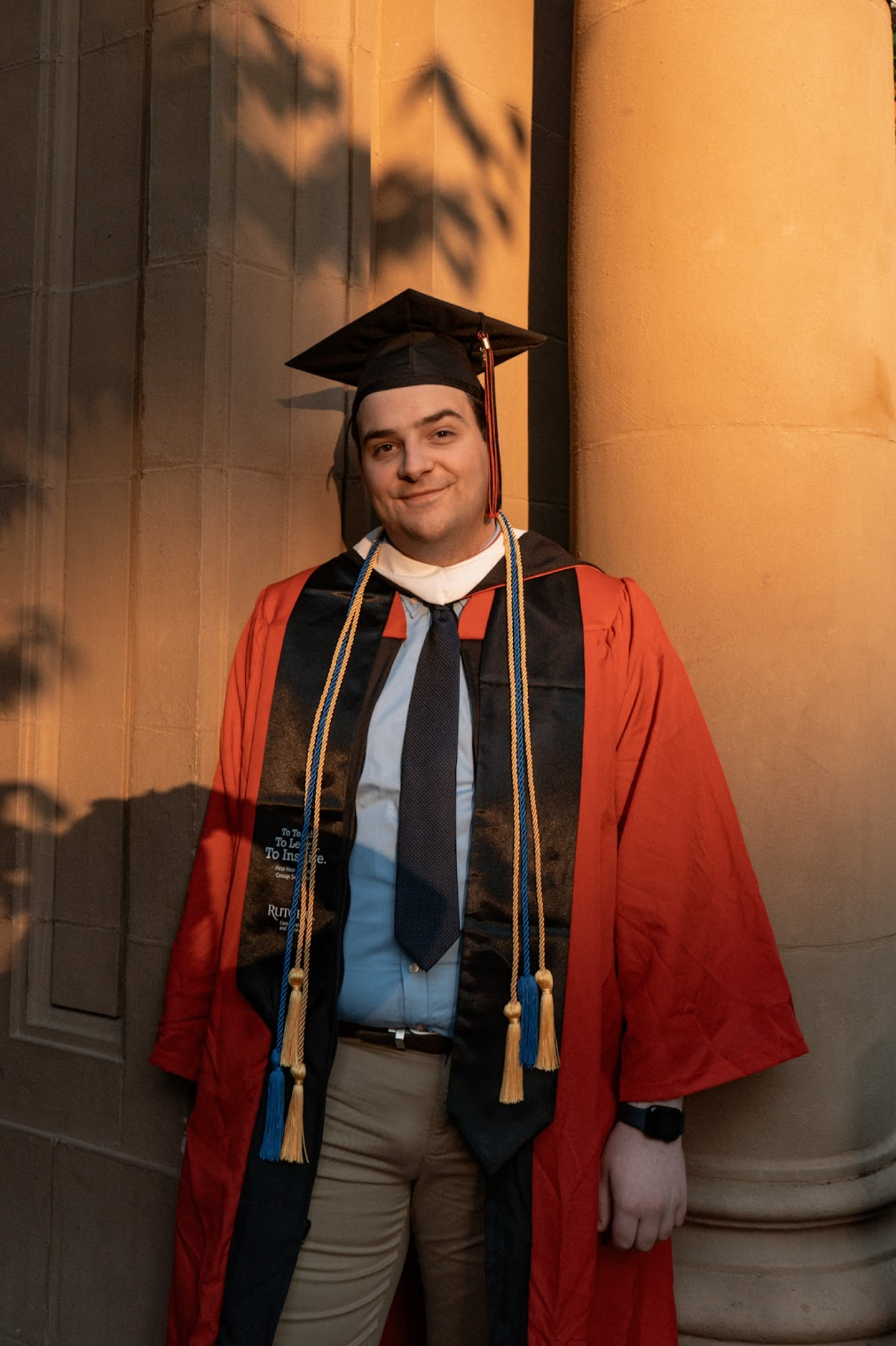
Higher Education
Teaching & Leadership at Rutgers University
Luke brings the same collaborative, student-centered approach that defines his work in the theater to the higher education classroom. At Rutgers University, he supports first-year student transitions, develops curriculum, trains peer instructors, and provides individualized academic coaching, reaching over 1,600 students annually.
Rutgers University
Program Coordinator & Course Instructor
First-Year Interest Group Seminars (FIGS)
Office of Career Exploration & Success
Current
Rutgers University
Academic Coach
Rutgers Learning Centers
New Brunswick, NJ
Current
Rutgers University
Peer Instructor
Introduction to Drama in Education (2026)
First-Year Interest Group Seminars (2022, 2023)
International Student Transition Seminars (2023, 2024)
2022 – 2024
FIGS Program — Rutgers University
Program Coordinator & Course Instructor
The First-Year Interest Group Seminars (FIGS) program reaches over 1,600 incoming students each year through 70+ sections of a career-focused seminar course. Luke coordinates program operations, supervises peer instructors, and teaches the instructor training course.
-
Provides administrative support to professional staff and instructors across 70+ seminar sections reaching over 1,600 first-year students annually.
-
Supervises an annual cohort of ten undergraduate peer instructors through weekly group advising, one-on-one meetings, performance documentation, and classroom support.
-
Participates in application review and serves as a lead interviewer in the recruitment and selection of over 300 candidates for the highly competitive Peer Instructor position.
-
Instructs Peer Instructor Education (01:090:320), a 3-credit course preparing undergraduate students to design and teach their own FIGS seminar sections.
Creates an inclusive, respectful environment
Clear expectations & communication
Approachable & supportive
Demonstrates strong leadership
"Luke has been very responsive to my questions and always is very supportive when something is going on in my class or with my behind-the-scenes work."
Peer Instructor — FIGS Program
"During our one-on-ones, Luke gave me a lot of insight into how to run my class, especially involving engaging quiet students."
Peer Instructor — FIGS Program
Rutgers Learning Centers
Academic Coach
Providing individualized coaching to undergraduate students navigating academic challenges — from time management and study skills to metacognition and goal-setting.
-
Designs individualized coaching plans addressing students' unique academic challenges, including time management, metacognition, study skills, and goal-setting.
-
Conducts individual coaching sessions and group workshops to support undergraduate students in developing metacognitive and academic skills.
-
Collaborates with learning center faculty and staff through regular meetings to enhance coaching skills and pedagogy.
"The instructor effectively created a safe space and cultivated the ability for the class to develop critical thinking skills."
Student — FIGS Seminar
"He showed a genuine interest in what he was teaching which encouraged others' intellectual growth and overall interest."
Student — FIGS Seminar
"My peer instructor was able to give me many tools for my success throughout my experience at Rutgers and professionally afterwards in life."
Student — FIGS Seminar
Undergraduate Courses
Courses Taught at Rutgers University
01:090:320
Peer Instructor Education
A 3-credit course preparing FIGS Peer Instructors to design and teach their own seminar sections. Students develop lesson plans, explore teaching philosophy, and build confidence as emerging educators.
Learning Outcomes
Successfully integrate FIGS Elements through a topical lens
Implement effective teaching techniques in the FIGS classroom
Develop confidence in individual teaching style
Demonstrate growth across 8 career readiness competencies
"Luke was very engaging and knew how to facilitate good discussions in a welcoming environment, which made the course that much more enjoyable."
Student Evaluation01:090:120
First-Year Interest Group Seminar — Exploring Theater
A one-credit seminar designed by Luke as a peer instructor to help first-year students explore theater as an academic discipline and connect co-curricular opportunities to career goals.
Learning Outcomes
Discuss foundational concepts related to theater
Navigate career exploration with greater confidence
Identify meaningful research and involvement opportunities
Build relationships and identify mentors within the Rutgers community
"He encouraged me to keep reaching my goals even if other people doubt me. My peer instructor gave me many tools for success at Rutgers and beyond."
Student Evaluation07:965:200
Introduction to Drama in Education
Guest lectures for undergraduate drama education students on inclusive pedagogy, lesson planning, and standards-aligned curriculum design for K–12 theatre classrooms.
Sessions Taught
Designing Inclusive Drama Classrooms — UDL, trauma-informed teaching, disability justice frameworks
Lesson Planning for Drama Educators — NJ Standards alignment, ABCD objectives, inclusive instructional design
01:090:124 & 01:090:227
International Student Transition Courses
Peer-led academic transition courses supporting international students in navigating their first semester at Rutgers — covering academic expectations, campus resources, identity, and goal-setting.
Courses
RU-FIT: First-Year International Transition (01:090:124)
Academic Coaching for International Students (01:090:227)
Teaching Philosophy
"I believe students learn most effectively when they have control over their own learning and when the environment functions as a collaborative space for inquiry, reflection, and constructing meaning. My role as an educator is to facilitate experiences that invite students to build knowledge through personal experience and creative problem-solving — prioritizing process, collaboration, and iterative exploration over polished outcomes."